Open Call for Emerging Artists: Summer Group Exhibition
Deadline for submissions: December 1, 2026 at 11:59PM
Smack Mellon invites submissions for a summer group exhibition to be guest-curated by Alma Chaouachi.
The open call takes as its departure point a public installation by artist and engineer Vishal Rawlley, who was commissioned to develop Hauz-i-Shamsi, or “Say Hello to the Hauz,” in a historic reservoir in Mehrauli, Delhi in 2010. Commissioned to make a case for ‘Internet art’ at a time where technology-based artistic practices were still being defined, Rawlley used networked technology to draw attention to the increasingly polluted reservoir, creating a way for the surrounding community to interact with it.
The artist built at the center of the reservoir a floating sculpture of a Buraq–a winged creature famous in Islamic mythology, also connected to the history and cultural associations of the reservoir–linked to a telephone line and an LED system. Rawlley distributed flyers with a number to call and a Skype link to access, allowing for visitors and neighbours to leave messages about the water and the pollution of the reservoir as they watched the illuminated sculpture from their computer. Some called to sing, others spoke of love—their voices activating the lights on the Buraq and encouraging more calls to keep it lit. Both the landline and the sculpture became interfaces through which the place could be addressed, listened to and reimagined.
Rawlley’s attempt at environmental awareness from the neighborhood was later judged unsuccessful and criticized, as it was perceived as a call for squatting and trashing the reservoir further. While he had deliberately designed the work to allow for unanticipated meanings and uses, in the uncanny traces of communal synchronization, play, and participation that emerged, the work became something other than what it had set out to be.
Inspired by this case-study, the exhibition invites artists to consider site-specificity, infrastructures, systems, and conditions that prompt an artwork–especially public–to become a site for collectivity. How does a work organize a site, a context, an audience, a set of actions, or a technology into a gathering? What happens when audiences use, interpret, or transform a work beyond the artist’s intent? And what responsibility does an artist have for what the work makes possible?
The call is not necessarily concerned with answers from digital or multimedia practices, but rather in works that operate as studies, proposals or systems for thinking through forms and conditions for collectivity. In addition to traditional visual artwork, this invitation will consider all media and vernacular forms, including technological systems, a set of instructions, an object, a photograph, a sculpture, a film, a drawing, or a sound piece.
To submit your artwork to this call, please be prepared with the following information and documents:
- Up to 3 images of your work that you wish to be included, and/or similar artworks.
- Images must be labeled in the following format:
- Lastname_Firstname_01.jpg
- Lastname_Firstname_02.jpg..
- etc.
- Up to 2 video excerpts may be included–each video can be 3 minutes maximum. Video submissions will be reviewed for up to 3 minutes, and not over.
- Please note that the videos should NOT include documentation of still artworks or exhibitions. Only time-based, moving-image, and/or performance-based works will be reviewed as video submissions.
- A corresponding image list document with the following information: title, date, medium, dimensions, and up to 100 words each of contextual information. (PDF only.)
- Brief artist statement (150-200 words. PDF only.)
- Current CV (PDF only.)
Artists will be notified in March 2027.
Details and Eligibility:
This call is only open to emerging artists. We define an emerging artist as one who is at the beginning of their public artistic career and would greatly benefit from the opportunities we provide. Artists may have some experience participating in group shows, solo shows at lesser-known art spaces, some press recognition, and/or are recent graduates of BFA or MFA programs. We do not consider artists emerging if they have had solo exhibitions at widely recognized galleries or institutions; already received consistent production opportunities, awards, and press; and/or if they have 10 years or more of consistent public experience/exposure as an artist. Age is not a determining factor. We understand the ambiguity of some of these terms, but hope they offer insight into our selection considerations.
Artists cannot be enrolled in degree seeking programs at the same time as this exhibition.
Smack Mellon can offer a small stipend for participation in this exhibition, which will be determined by the Curator once all artists are selected. We do not have the funds to commission new artworks. Smack Mellon also does not have a budget for shipping, transportation, or on-site production. For that reason, this call is only open to artists living and working in the greater New York City area.
Smack Mellon hires a small art handling team for each exhibition installation and deinstallation, but artists are responsible for providing Smack Mellon with instructions on safe handling. Artists are expected to be on site for the installation and de-installation of their work unless other arrangements have been made with the Curator and Smack Mellon’s staff. Artists are expected to arrange safe and timely transport of their works to and from the gallery.
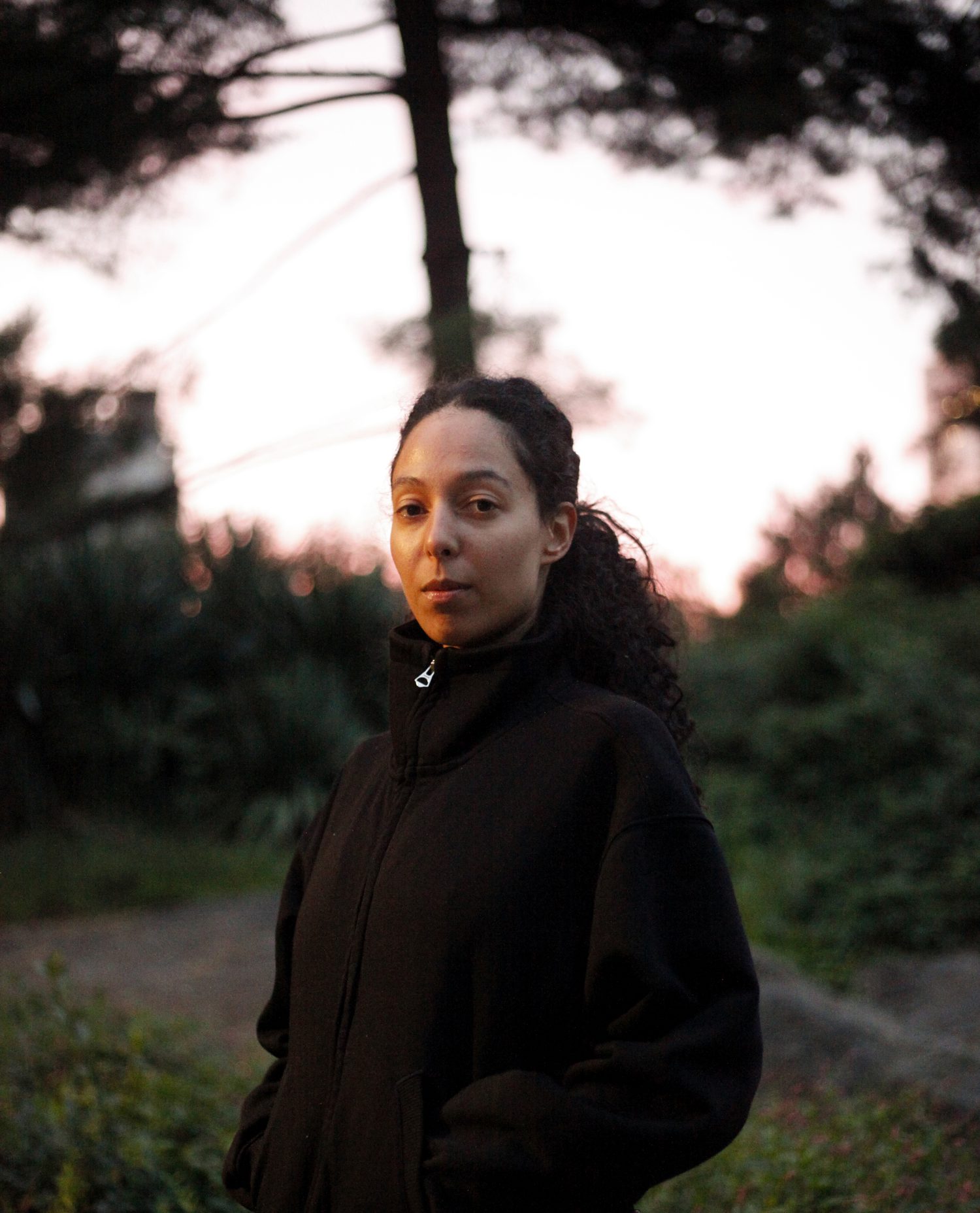
Curator
Alma Chaouachi is a curator based in New York whose practice primarily focuses on contemporary art from SWANA and its diasporas. She approaches curating as a research method grounded in exchange and collaboration with artists, cultural workers, researchers, and institutions. She holds a Master’s degree in Art History from La Sorbonne, Paris, and a Master’s in Curatorial Studies from Bard College. She has worked in artists’ studios, including Randa Maroufi’s, as well as at contemporary art institutions such as KADIST and the Hessel Museum of Art, where she curated the first U.S. exhibition dedicated to the American-Egyptian music pioneer Halim El-Dabh.
Headshot: by Pejota
Image: Screenshot from a film by Vishal Rawlley showing interaction with his installation Say Hello to the Hauz, 2010. (Source: YouTube)